User Experience Design — UX Design — is one of the most widely used and most misunderstood disciplines in the digital world. Everyone seems to have a vague idea of what it means, few can define it precisely, and many confuse it with graphic design or "making things look nice". In 2026, UX has matured into a real profession with established methods, recognized educational paths, and an international community of practitioners — yet explaining what it actually is remains a challenge.
This article is an introductory guide to User Experience Design in 2026: what it is, where it came from, its main areas, how it differs from related disciplines, and why it has become one of the most in-demand skills in tech.
What you'll learn:
- What "User Experience Design" really means
- The historical origins of the discipline
- The 5 areas that make up modern UX
- The typical UX project process
- How UX differs from Usability, UI Design, and Product Design
- How UX has evolved by 2026
What is UX Design
User Experience Design is the discipline of designing how people experience their interaction with a digital product, service, or system. The goal is to make that interaction:
- Useful: it solves a real user problem
- Usable: it's easy to use without instructions
- Accessible: it works for everyone, including people with disabilities
- Enjoyable: it creates satisfaction, not frustration
- Consistent: it behaves the way users expect
Don Norman — one of the founders of the discipline and author of the seminal book The Design of Everyday Things — coined the term "user experience" in the 1990s while working at Apple. His definition: "User Experience encompasses all aspects of the end-user's interaction with the company, its services, and its products."
The definition is intentionally broad. UX isn't just the digital product: it's everything that happens between the user and the brand — from the first marketing touchpoint to post-sale support. In day-to-day practice, UX designers work primarily on digital products, but the concept extends to services, events, and physical experiences.
Origins of the discipline
The roots of UX run deeper than most people think — and they predate the digital era.
Human Factors and Ergonomics (1940s–60s)
During World War II, American military designers realized pilots were crashing not because they lacked skill, but because cockpit layouts were badly designed: switches that looked identical controlled opposite functions, labels were hard to read, levers were in unnatural positions. This gave birth to Human Factors, the discipline of adapting tools to the physical and cognitive capabilities of the humans using them.
In the 1960s, designers like Henry Dreyfuss and Alvin R. Tilley brought this approach into industrial design: everyday objects designed around the human body.
Human-Computer Interaction (1970s–80s)
With the arrival of the first personal computers came the study of how humans interact with machines. Xerox PARC invented the GUI (Graphical User Interface), the mouse, and the icon-based desktop in the 1970s. Apple brought these ideas to the mainstream with the Macintosh in 1984.
The first documented usability tests date to the 1980s. Jakob Nielsen, then an HCI researcher, published the famous 10 usability heuristics in 1994 — principles that are still valid 30 years later.
The birth of UX (1990s–2000s)
Don Norman joined Apple in 1993 and coined the title "User Experience Architect" to describe his work — he wanted a term broader than "usability engineer" to capture the full end-to-end experience. The phrase caught on fast.
The web boom of the 2000s and the iPhone launch in 2007 pushed UX into the mainstream. A whole generation of users came to expect excellent digital experiences by default — and that made UX a strategic priority for every company, from Silicon Valley giants to mid-market SaaS players.
The 5 areas of modern UX
Modern UX is an umbrella that covers five interconnected disciplines. Mature product teams — think companies like Airbnb, Stripe, or Notion — have specialists in each, though in smaller organizations these roles are often combined into a single generalist.
1. User Research
The discipline that collects data about real users through interviews, usability tests, behavioral analysis, and surveys. It answers the question "who are the users, and what do they actually want?". Read our guide to user research to go deeper.
2. Information Architecture
The organization and labeling of a product's content. How it's categorized, navigated, and searched. Read our guide to information architecture.
3. Interaction Design
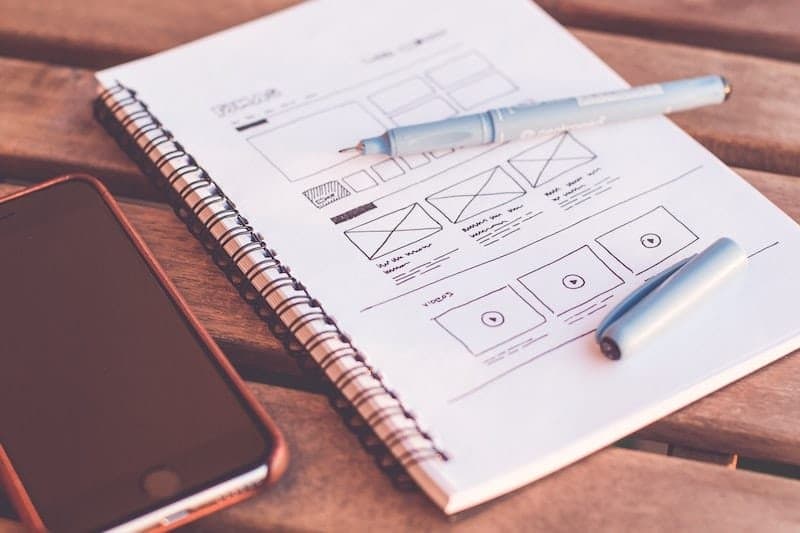
The design of how the user interacts with the system: flows, wireframes, prototypes, behaviors, states. Read what Interaction Design is.
4. Visual / UI Design
The visual language of the product: typography, color, components, and design systems. Read our guide to UI Design.
5. UX Writing
The textual language of the interface: labels, buttons, messages, microcopy. A young but rapidly growing discipline. Read what UX Writing is.
The five areas are interdependent: a beautiful interface (Visual) with confusing copy (Writing) will fail. A logical flow (Interaction) built on chaotic information architecture (IA) will still confuse users. A generalist UX designer works across all five; a specialist focuses on one.
The typical UX project process
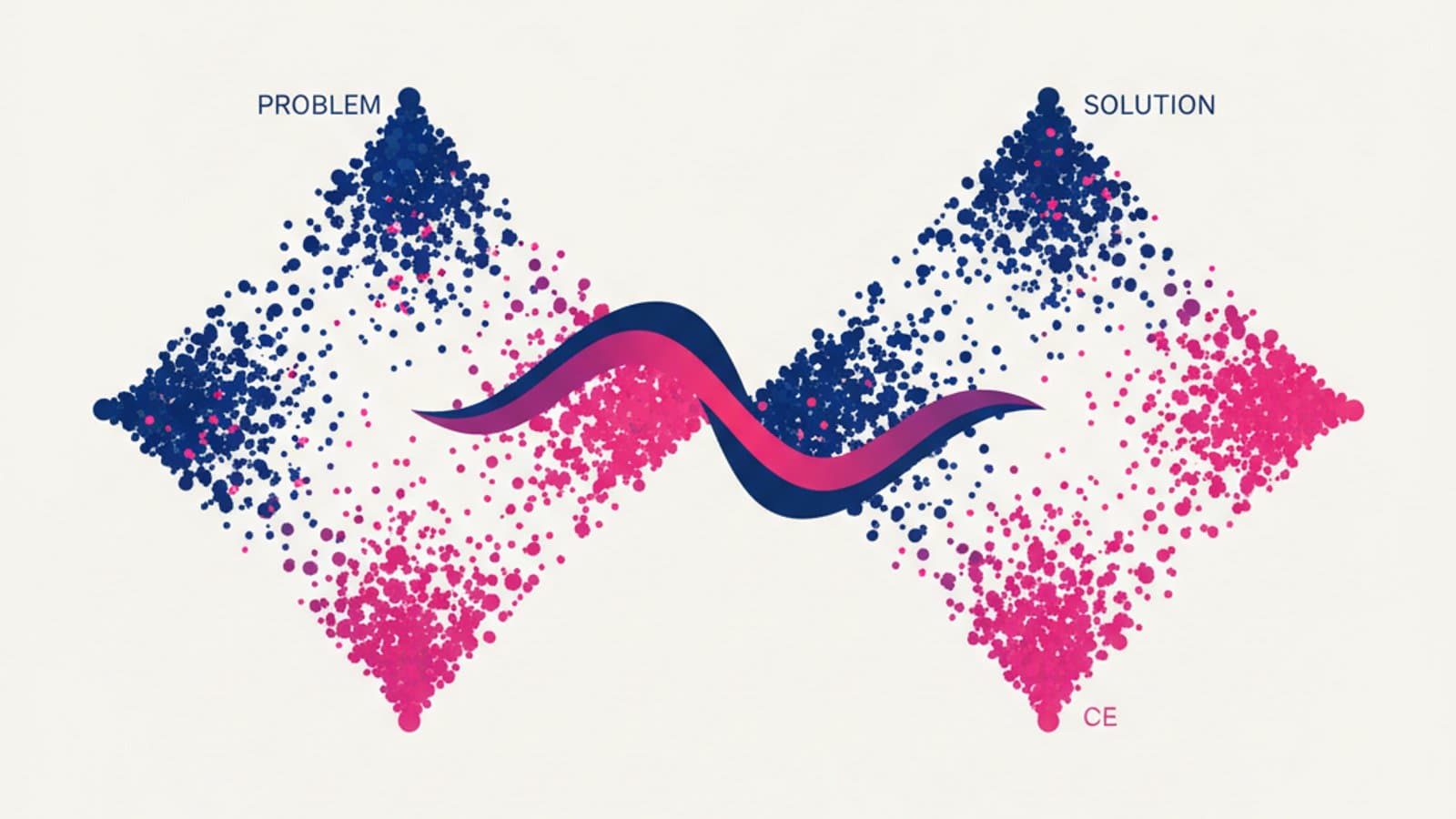
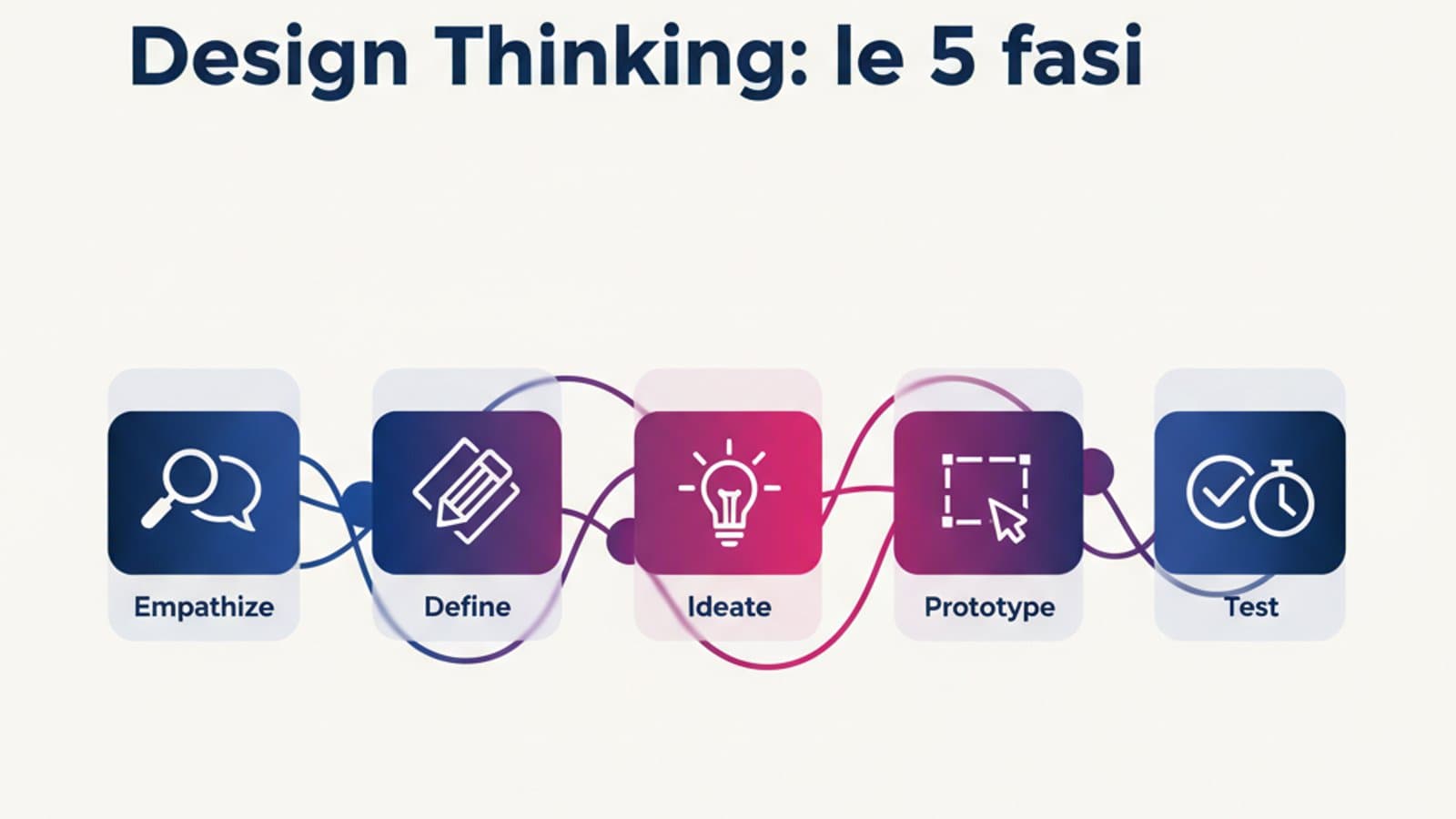
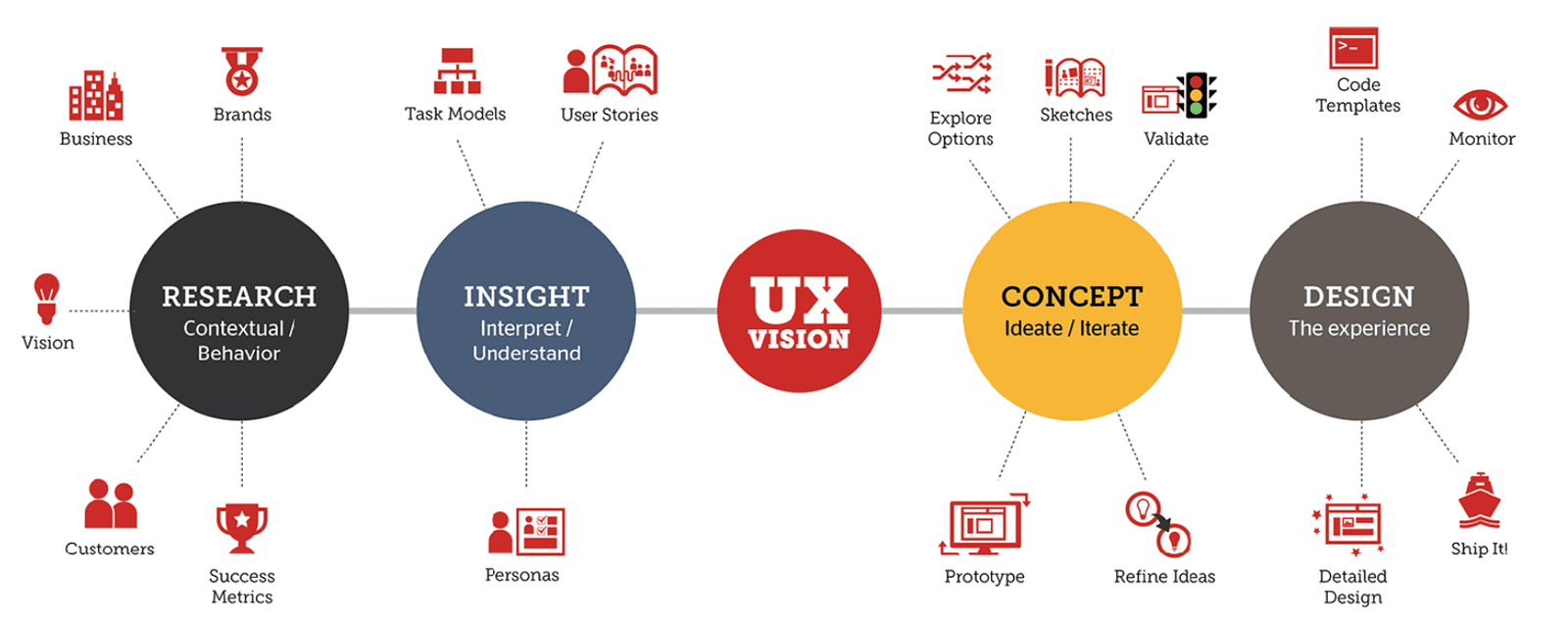
Despite the variety of methodologies (Design Thinking, Lean UX, Double Diamond, Dual-Track Agile), most UX projects follow a similar sequence of stages:
1. Discovery / Research
You understand the problem. User interviews, competitor analysis, review of existing data, stakeholder workshops. The output is actionable insights.
2. Definition / Synthesis
You translate insights into well-framed problems. Personas, journey maps, problem statements. The output is a clear picture of what to build and why.
3. Ideation
You explore solutions. Brainstorming workshops, sketches, alternative proposals. The output is a range of possible directions.
4. Prototyping
You build the most promising solutions as wireframes and prototypes. No production code yet. The output is a testable design.
5. Testing
You test prototypes with real users (usability tests, cloze tests, preference tests, A/B tests). You measure what works and what doesn't.
6. Implementation
You hand the design off to engineering, follow implementation, and correct deviations. The output is the shipped product.
7. Measurement & Iteration
After launch, you monitor metrics (conversion, retention, satisfaction). You identify what to improve in the next cycle.
This process is not linear: in a mature Agile team, phases overlap, iterate, and repeat. Read our guide to UX Design and Agile for a deeper dive.
How UX differs from related disciplines
UX vs Usability
Usability is a component of UX: how easy a product is to use. UX is broader — it includes usability but also desirability, utility, accessibility, and emotion. A usable but boring product is not a good UX; a delightful but unusable one isn't either.
UX vs UI Design
UI Design is the "how it looks". UX includes UI but goes further: it also includes research, architecture, interaction, and writing. In most companies — especially outside of major tech hubs — the two roles are often combined into a single "UX/UI Designer" generalist position.
UX vs Product Design
Product Design is often used as a synonym for "mature, strategic UX Design". A Product Designer is typically a senior UX generalist who also participates in product decisions (what to build, not just how). In US tech companies like Google, Meta, and Airbnb, this is the preferred title; in European and smaller markets, "UX Designer" or "UX/UI Designer" is still more common.
UX vs Customer Experience
Customer Experience (CX) is the overall experience with a brand — including digital, but also customer support, physical stores, marketing, and post-sales. UX is a sub-discipline of CX, focused specifically on the digital layer.
How UX has evolved in 2026
Three trends are reshaping the discipline right now:
1. AI is reshaping the workflow
AI tools (Figma AI, Galileo, Uizard, v0.dev) now generate first-pass designs from text prompts. Designers aren't disappearing, but their role is shifting from executor to curator and decision-maker. Juniors who learn only Figma without strategic context are at risk of being replaced; designers who know what to build and why become more valuable than ever.
2. Accessibility has become law
Accessibility is no longer optional. In the US, the ADA (Americans with Disabilities Act) and Section 508 have long required digital accessibility for public-sector and many private sites. In the UK, the Equality Act 2010 sets similar expectations. And in Europe, the European Accessibility Act took effect on 28 June 2025, making digital accessibility mandatory for most private-sector services. A UX Designer in 2026 needs to master WCAG 2.2 — it's no longer a "nice to have". See our guide to color accessibility as an example.
3. Remote work has democratized the market
A designer in Ohio, London, or Lisbon can now work for companies headquartered anywhere. Geography is no longer the limit it used to be. The best 2026 salaries go to designers who tap into global remote markets — and the competition is global too. Read our guide to remote UX design work.
Frequently asked questions
What's the difference between UX and UX Design?
"UX" (User Experience) is the user's experience — the result. "UX Design" is the discipline that designs that experience. In everyday language the two are used interchangeably, but technically they're distinct: UX is the output, UX Design is the process.
Who invented UX?
Don Norman coined the term "User Experience" in the mid-1990s at Apple, but the roots of the discipline run deeper: military Human Factors in the 1940s, academic HCI in the 1970s–80s, usability engineering in the 1990s. Norman gave a name to an evolving field — he didn't create it from scratch.
Is UX a scientific discipline?
Partly yes: it uses rigorous research methods (interviews, statistical tests, quantitative analysis). Partly no: it also involves sensitivity, intuition, and creativity that are not strictly scientific. It's a hybrid discipline that combines scientific method and design thinking.
What are the essential books to understand UX?
To get started: Don't Make Me Think by Steve Krug (short, practical), The Design of Everyday Things by Don Norman (theory and philosophy), and About Face by Alan Cooper (a complete guide to interaction design). To go deeper: User Experience Team of One by Leah Buley, Lean UX by Jeff Gothelf, and Articulating Design Decisions by Tom Greever. See our roundup of the best UX design books.
Is it too late to enter UX in 2026?
No. The market has matured but continues to grow. Junior roles are more competitive than 10 years ago, but mid-level and senior roles remain in high demand. Read our guide to becoming a UX Designer to plan your path.
Will UX disappear because of AI?
It transforms, it doesn't disappear. AI tools automate execution-level tasks but don't replace strategic thinking, empathy for users, the ability to negotiate with stakeholders, or understanding of business context. UX Designers who learn to use AI as a tool will stay relevant; those who don't risk being left behind.
Next steps
If you want to go deeper into UX Design as a profession or a skill to acquire:
- Read what a UX Designer actually does for the practical role
- Study our 12-month roadmap to plan your learning path
- Go deeper into Interaction Design — the operational core of UX
The complete UX Design course by CorsoUX covers all 5 UX areas with senior mentors who guide you through building a professional portfolio from scratch or from any background.