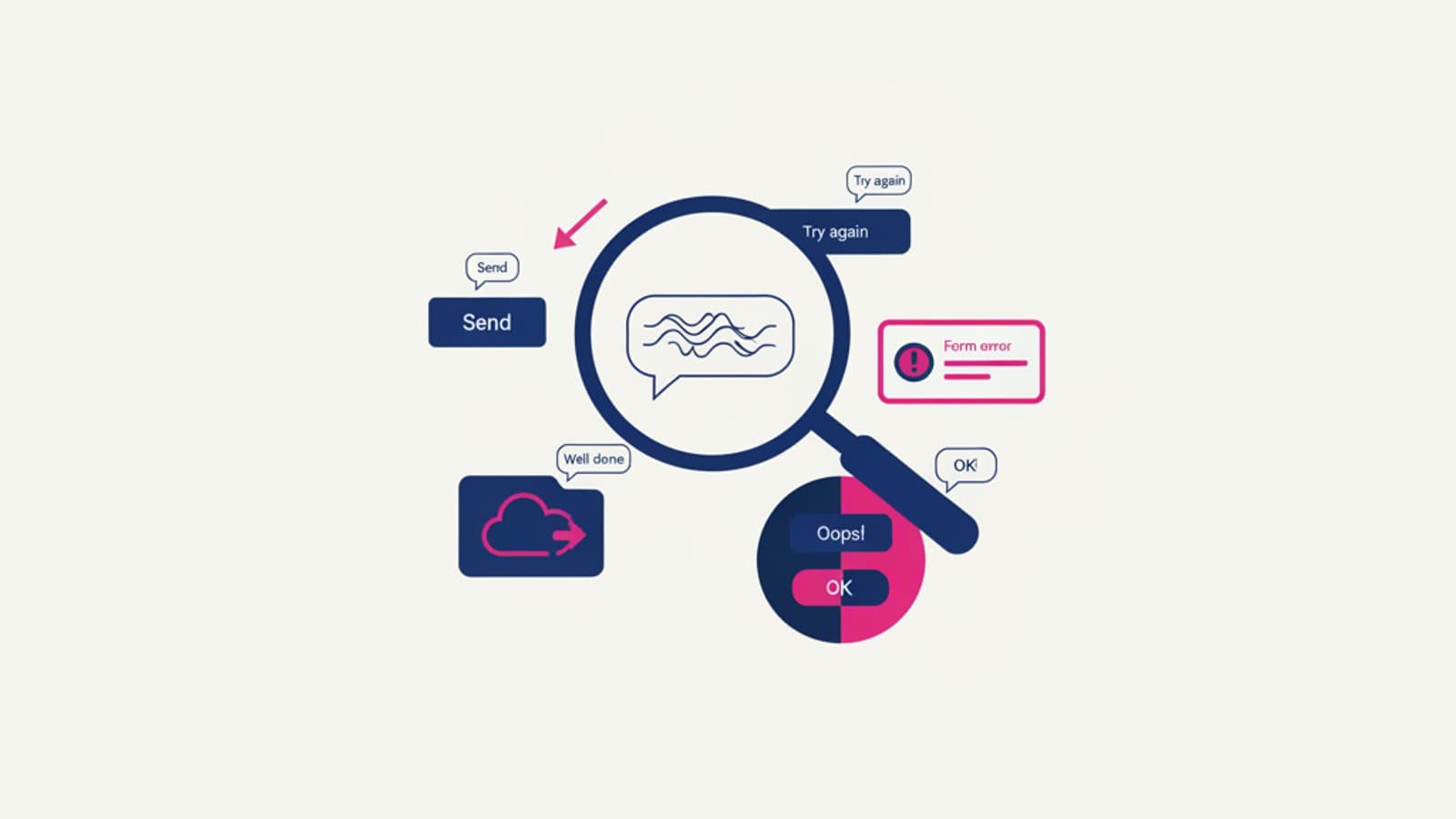
Every word you see in a digital interface was written by someone. The button text, the error message, the field label, the confirmation line, the empty-state headline — every single character is a design decision. UX Writing is the discipline that owns those decisions, and over the last few years it has moved from being a design "accessory" to a standalone specialization with its own method, professionals, and tools.
This article explains what UX Writing is, the core principles, how it differs from traditional copywriting and content strategy, and how to start writing better interface copy even if you're not a full-time UX Writer.
What you'll learn:
- What UX Writing is and how it differs from other kinds of writing
- The 6 core principles that make interface text useful, not decorative
- The typical elements a UX Writer works on every day
- How to build a consistent voice and tone for a product
- How to start doing UX Writing even if you're not a dedicated writer
What is UX Writing
UX Writing is the practice of writing functional text for digital interfaces: labels, buttons, error messages, empty states, onboarding, confirmations, notifications. Its goal isn't to entertain or to persuade (like advertising copy), it's to guide the user through the experience as clearly and quickly as possible.
The most concise definition comes from Kinneret Yifrah, author of Microcopy: The Complete Guide: UX Writing is "the voice of the product".
The distinctive characteristics compared to other forms of writing:
- It's functional before it's aesthetic: a beautiful sentence that confuses is a bad sentence
- It lives inside the interface, not next to it: a button's label is part of the component, not something added afterward
- It's a system, not isolated pieces: a UX Writer works on consistent voice and tone, not individual strings
- It has metrics: it's tested with real users, you measure conversion shifts, completion rates, task time
UX Writing vs Copywriting vs Content Strategy
Three neighboring disciplines that are nonetheless distinct. Concrete example: the launch of a new feature.
- Copywriting (advertising): writes the marketing campaign, the social post, the promotional landing page. Goal: convince people to click.
- Content Strategy: defines the overall communication strategy, key messages, content governance. Goal: strategic consistency.
- UX Writing: writes the text inside the product (feature onboarding, tooltips, confirmation messages, errors). Goal: guide use.
The three overlap — a UX Writer needs to know copywriting, a content strategist needs to understand UX Writing — but they produce different outputs with different methods.
The 6 core principles of UX Writing
1. Clarity above all
The first and most important principle. Interface text has to be understandable at first glance by an average user in your target audience. Ambiguity, jargon, and complex sentence structures are the enemy.
Bad example: "The authentication procedure has been successfully carried out."
Good example: "Welcome. You're in."
Clarity is measurable: if a reader has to go over it twice, the text is too complex.
2. Intentional brevity
Interfaces have limited space and users have limited attention. Text should be as short as possible while staying clear. Not "absolute minimum" but "necessary minimum".
Bad example: "Please enter your email address in the field below to proceed with the registration process."
Good example: "Your email"
3. Concreteness, not abstraction
Concrete text is more comprehensible than abstract text. "3 business days" is more concrete than "soon". "You have 7 unread messages" is more concrete than "New activity".
Bad example: "We're processing your request"
Good example: "Sending — this takes a few seconds."
4. Tone consistent with the brand
How a product "speaks" should reflect its personality. A kids' app talks differently from a banking app. The same message — "there's nothing in your cart" — can be written in 10 different ways, each one consistent with a different personality.
Examples of different tones for the same message:
- Formal: "Your cart is currently empty."
- Neutral: "Your cart is empty."
- Friendly: "Cart's still empty. Let's give it something to carry."
- Playful: "Cart as empty as a Sunday morning. Let's explore!"
None of the four is objectively "right": it depends on the brand.
5. Honesty, not dark patterns
UX Writing must not manipulate users. Dark pattern text — ambiguous phrases designed to push people into choices against their own interest — is ethically wrong and increasingly targeted by regulators. In the EU, the Digital Services Act (DSA) and the Digital Markets Act (DMA) explicitly regulate them as of 2024. In the US, the FTC has been cracking down on deceptive design practices since 2022, and California's CCPA prohibits dark patterns in consent flows.
Dark pattern example: "I don't want to save 20%" as the opt-out option for a coupon. It makes refusing feel irrational.
Honest example: "No thanks" as a normal option.
6. Accessible to everyone
UX Writing has to work for everyone: people with low literacy, people using screen readers, non-native speakers. Short clear sentences help everyone. Complex structures, technical terms, and double negatives lock out whole groups of users.
A good readability indicator for English is the Flesch-Kincaid score. Free online tools compute it instantly. A score of 60+ means your text is readable for most adults; 70+ is easy to read for a wide audience. The Hemingway App and Grammarly both expose readability scores as you write.
What a UX Writer touches every day
A typical day of UX Writing includes work on:
- Buttons and CTAs: "Book", "Send", "Continue"
- Form labels: "Email address", "Password", "Billing ZIP"
- Placeholders: example text inside input fields
- Help text: short explanations under fields ("We'll only use your email to sign you in")
- Empty states: text for blank screens ("No orders yet — browse the catalog")
- Error messages: text for when something goes wrong
- Success messages: confirmations of completed actions
- Onboarding flows: the first screens that introduce a product
- Push and in-app notifications
- Tooltips and contextual microhelp
- Technical terms and glossaries
Each of these elements has its own conventions and best practices. A senior UX Writer knows them all.
How to build voice and tone
Voice is the product's personality — constant. Tone is the adaptation of that voice to context — variable.
Example: a banking app might have a voice that's "trustworthy, clear, reassuring". The tone shifts with the context:
- Successful payment confirmation: tone is positive, concise
- Payment error: tone is reassuring, practical
- Legal notice: tone is formal, precise
- New user onboarding: tone is friendly, simple
How to define it
A standard voice & tone document includes:
- 3–5 voice attributes (e.g. "clear, warm, rigorous") with short definitions
- What the product is / what the product isn't (e.g. "A knowledgeable friend / Not a cold robot")
- Concrete examples of good vs bad writing
- Tone matrix: how tone shifts across 4–6 typical contexts (onboarding, error, success, information, warning, celebration)
- Glossary: approved terms and banned terms
This document becomes the reference every writer (and designer) uses to stay consistent. Mailchimp's content style guide is the gold standard and is published publicly at styleguide.mailchimp.com — worth studying.
How to start doing UX Writing
If you're a designer who wants to improve the text in your products, or you want to evaluate UX Writing as a career, here are the practical steps.
1. Read the fundamentals
- Microcopy: The Complete Guide by Kinneret Yifrah — the industry reference manual
- Strategic Writing for UX by Torrey Podmajersky — structured and methodical approach
- Writing Is Designing by Michael Metts and Andy Welfle — how to integrate writing and design
- Nicely Said by Nicole Fenton and Kate Kiefer Lee — great intro for beginners
2. Study the voice of brands you admire
Analyze the language of Mailchimp, Duolingo, Slack, Notion, Linear, Stripe. Notice how their way of speaking is recognizable and consistent across the whole product. Then try rewriting screens from other products "in the voice of Mailchimp" as a practice exercise.
3. Review the copy in your current designs
Take one of your own projects (or an existing interface from any product) and review every piece of text with a UX Writer's eye. You'll discover 50–70% of the copy can be immediately improved.
4. Learn content testing methods
The cloze test, content testing, and preference tests on copy variants are concrete methods to validate your work with real users.
5. Build specific case studies
If you want to evaluate UX Writing as a career, build 2–3 case studies where you show the process: problem → research → variants → testing → outcome. A UX Writing portfolio is a portfolio of documented before/after work, not a collection of decorative screenshots.
Frequently asked questions
Is UX Writing its own profession or part of design?
Both. Large companies (Google, Microsoft, Atlassian, Shopify, Airbnb) have full-time dedicated UX Writers. In mid-sized companies UX Writing is often done by the designers themselves. In smaller teams and startups, whoever is writing product copy is doing UX Writing — whether they have the title or not.
Do you need a humanities degree to do UX Writing?
No, but it helps. The best UX Writers come from journalism, copywriting, literature, translation, and teaching — all paths where writing craft has been sharpened. Designers can become strong UX Writers with time and focused reading.
How much does a UX Writer earn in the US and UK?
Data from Glassdoor, Levels.fyi and Built In in 2025:
- United States: junior $75k–$100k · mid $100k–$140k · senior $140k–$185k · principal $185k–$250k+ (top of market: Google, Meta, Airbnb with stock can exceed $350k total comp)
- United Kingdom: junior £32k–£45k · mid £45k–£70k · senior £70k–£100k · lead £100k–£135k
It's a niche with relatively low supply-side competition, so there's room for people who specialize early.
Can you do UX Writing in a second language?
Yes, and it can be an asset. Many international tech companies look for bilingual writers. A native Spanish or Italian speaker who can write natural product English is a rare and highly valued skill.
Will AI replace UX Writers?
It's automating baseline copy (placeholders, simple labels) but not the strategic work of defining voice and tone, testing with users, negotiating decisions with stakeholders. UX Writers who use AI as a tool will stay relevant; those who only wrote boilerplate copy are at risk.
Does UX Writing only matter for B2C products?
No — B2B needs UX Writing too, often even more. Complex dashboards, enterprise software, data analysis tools — they all need clear, comprehensible text. B2B products are often the market where UX Writing makes the biggest difference.
Next steps
UX Writing is a cross-cutting skill that improves the work of every designer. To keep going:
- Study the cloze test for content testing
- Go deeper on how to test interface content
- Read about what a UX Designer does day to day and how writing fits in
The CorsoUX UX Writing module is one of the 4 main pillars of our program, with practical exercises on real projects and mentors who review every single piece of copy you write.