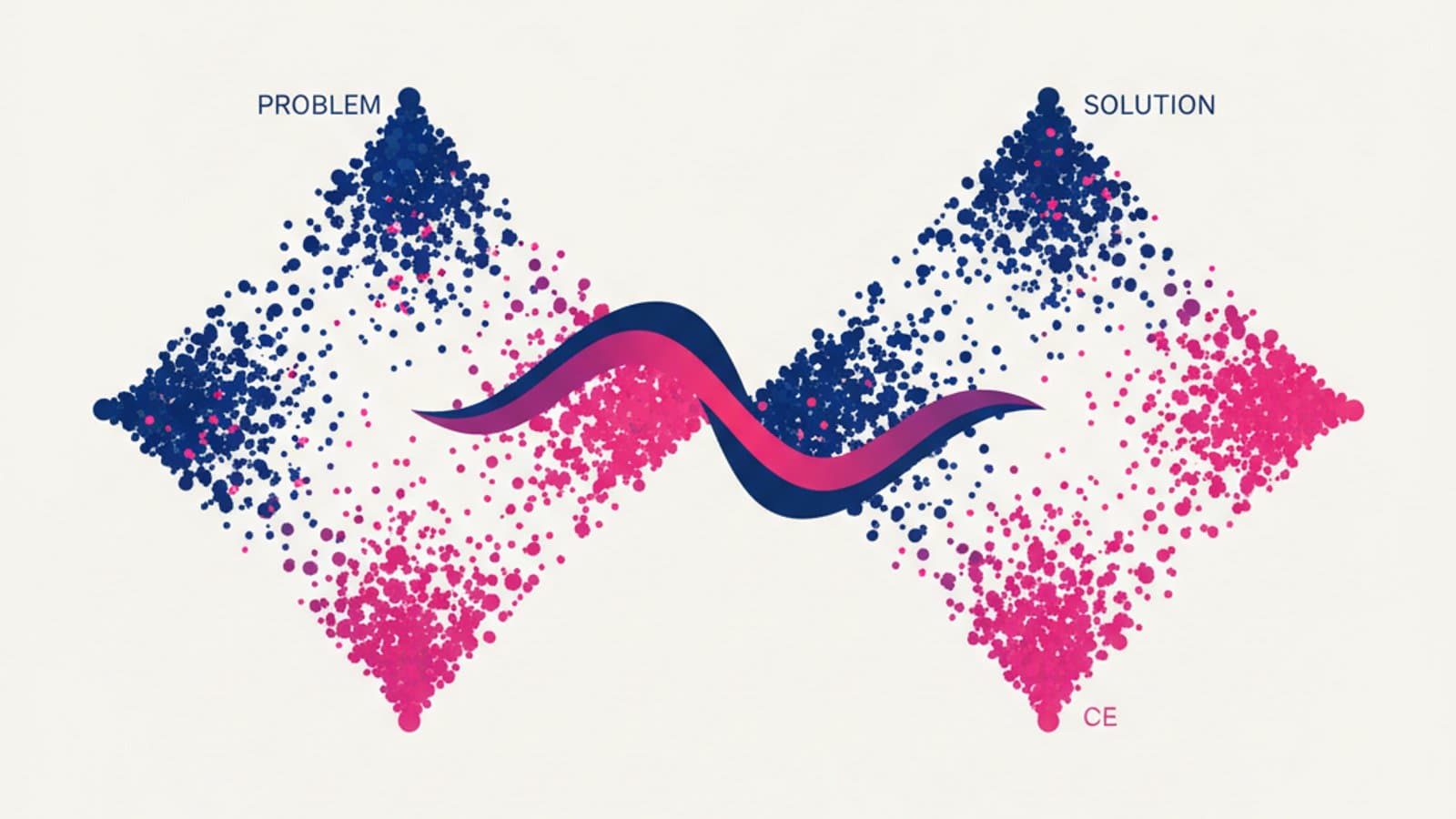
The Double Diamond is a design framework created in 2005 by the British Design Council. Its name comes from its visual shape: two adjacent diamonds, each divided into a divergent (wide) phase and a convergent (narrow) phase. Each diamond represents a moment of exploration followed by a moment of decision. The first diamond explores the problem; the second explores the solution.
It's one of the world's most cited design frameworks and is widely used in strategic innovation and public service projects. While Stanford's Design Thinking emphasizes rapid iteration, the Double Diamond focuses on the clear distinction between "understanding the problem" and "designing the solution." This principle helps prevent the most common design mistake: building the right solution for the wrong problem.
In this guide, we'll explain what the Double Diamond is, how its four phases work with practical examples, its history, its differences from classic Design Thinking, and when to choose one over the other for your projects.
What you'll learn in this article:
- The history of the Double Diamond and why the British Design Council created it.
- The 4 phases (Discover, Define, Develop, Deliver) explained with concrete activities.
- The principle of divergence/convergence that makes the framework so powerful.
- The difference between the Double Diamond and Design Thinking, and when to use each.
- 3 real-world examples of projects solved using the Double Diamond.
- The 4 Design Council principles that complement the 4 phases.
What is the Double Diamond?
The Double Diamond is a visual model of the design process. The dual diamond shape communicates two ideas simultaneously:
- The process is not linear: it alternates between divergent (exploring) and convergent (deciding) phases.
- There are two "problems" to solve: first, understanding what the right problem is, and then designing how to solve it.
Each diamond represents one of these two moments, and each contains two phases: an "opening" (divergence) and a "closing" (convergence), for a total of four phases.
The 4 Phases: Discover, Define, Develop, Deliver
The Double Diamond is also known as the "4D model" because its phases are:
- Discover — divergence of the first diamond: gathering insights, exploring the context, user research.
- Define — convergence of the first diamond: synthesizing insights into a clear problem statement.
- Develop — divergence of the second diamond: ideation, prototyping, exploring alternative solutions.
- Deliver — convergence of the second diamond: testing, implementation, and launching the final solution.
Visually:
    Discover    Define          Develop    Deliver
       ╲         ╱                 ╲         ╱
        ╲       ╱                   ╲       ╱
         ╲     ╱                     ╲     ╱
          ╲   ╱                       ╲   ╱
           ╲ ╱                         ╲ ╱
            V                           V
        problem                    solution
The point at the center of each diamond—where the lines converge—represents a moment of clarity: at the end of the first diamond, you know what the problem is; at the end of the second, you know how to solve it.
History: Why Was It Created?
The Double Diamond was formalized in 2005 by the British Design Council, a UK public body founded in 1944 to promote design as a driver of economic innovation. In the 2000s, the Design Council studied how design teams at the UK's most innovative companies (like IDEO, Fjord, and Seymourpowell) worked and sought to distill a common model.
The result was the Double Diamond: a framework abstract enough to apply to any discipline (product design, architecture, services, strategy) but concrete enough to provide structure to a project.
In 2019, the Design Council published an updated version called the "Framework for Innovation," which adds four guiding principles and a component of "leadership and engagement" outside the core diamonds, acknowledging that design doesn't exist in a vacuum.
The 4 Phases in Detail
Phase 1 — Discover (The First Diamond Opens)
Objective: To understand the context, the users, and the nuances of the problem without jumping to solutions.
This is the divergent phase: you explore broadly, gather as much data as possible, and embrace contradictions. You don't filter yet; you accumulate knowledge.
Typical Activities:
- User research: interviews, shadowing, diary studies with 8-15 users.
- Stakeholder interviews: understanding business goals and constraints.
- Desk research: analyzing existing data, customer support tickets, reviews, analytics.
- Competitive analysis: how have others approached similar problems?
- Ethnographic observation (for service design projects): observing people in their real-world context.
Typical Deliverables: Research notes, interview transcripts, raw data, empathy maps, preliminary journey maps.
Typical Duration: 2-6 weeks for an average project.
Phase 2 — Define (The First Diamond Closes)
Objective: To synthesize all the gathered knowledge into a clear and actionable problem statement.
This is the convergent phase: you filter, choose, and prioritize. A great output from the Define phase is a sentence (or a few sentences) that anyone on the team can use as their North Star.
Typical Activities:
- Affinity mapping of research insights.
- Personas and user need statements: "[This type of user] needs to [achieve a goal] because [of an insight]."
- Problem statements: "How might we help X do Y in context Z?"
- Problem prioritization: not all problems can be solved—choose 1-3 core issues.
- Design brief: a formal document capturing the defined problem, users, constraints, and success criteria.
Main Deliverable: The Design Brief, shared with the entire team. This is the true output of the first diamond.
Typical Duration: 1-2 weeks.
Phase 3 — Develop (The Second Diamond Opens)
Objective: To generate and test many possible solutions to the defined problem.
This is another divergent phase: brainstorming, sketching, rapid prototyping. There isn't one solution to defend—there are 10 alternatives to explore to find the best one.
Typical Activities:
- Ideation workshops with a cross-functional team.
- Sketches and storyboards of candidate solutions.
- Low-fi prototypes (wireframes, paper, low-fidelity Figma mockups).
- Co-design sessions with users (bringing users into the ideation process).
- Rapid testing of single hypotheses (not the entire product).
Deliverables: Multiple prototypes, alternative flows, a "shortlist" of 2-3 promising solutions.
Typical Duration: 3-6 weeks.
Phase 4 — Deliver (The Second Diamond Closes)
Objective: To validate, refine, and launch the chosen solution.
The final convergent phase: you test the shortlist with real users, refine the winning concept, and prepare it for production.
Typical Activities:
- Usability testing of the finalist solutions.
- A/B testing where applicable.
- Final high-fidelity prototype.
- Handoff to the development team with detailed specifications.
- Launch planning: roll-out, communication, post-launch monitoring.
- Success metrics: defining what to measure after launch.
Deliverables: The implemented solution + a measurement plan.
Typical Duration: 2-4 weeks for design, followed by development and launch.
The 4 Design Council Principles (2019)
The 2019 update to the Double Diamond adds four principles that should guide every phase, regardless of where you are in the process:
1. Put People First
Always start with the end-users: who they are, what they do, what they need to accomplish, and what their strengths and challenges are.
2. Communicate Visually and Inclusively
Help people understand the problem and potential solutions through visual tools: diagrams, prototypes, storyboards. The more diverse the participants, the better the design works.
3. Collaborate and Co-create
Work with and be inspired by others—especially people with different backgrounds from your own. The best design comes from diverse teams.
4. Iterate, Iterate, Iterate
Build it, test it, repeat. No solution is perfect on the first try. Iteration isn't failure; it's the process itself.
Double Diamond vs. Design Thinking: Which to Use
These two frameworks are often confused or considered synonymous. In reality, they differ in emphasis and application context.
| Double Diamond | Design Thinking | |
|---|---|---|
| Origin | British Design Council, 2005 | Stanford d.school / IDEO, 1990s |
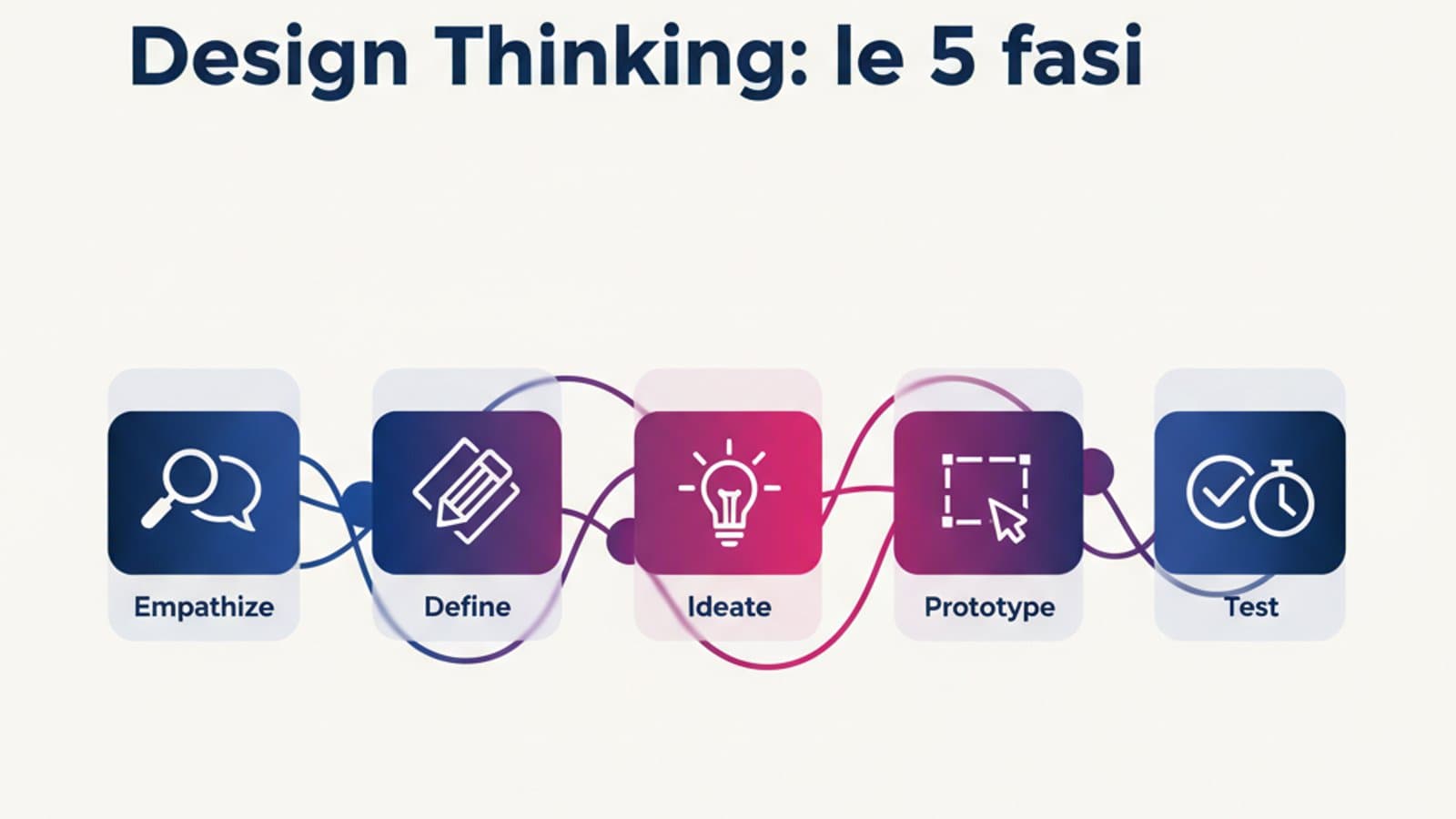
| Number of Phases | 4 (Discover, Define, Develop, Deliver) | 5 (Empathize, Define, Ideate, Prototype, Test) |
| Emphasis on the "right problem" | Very strong (first diamond) | Present but less explicit |
| Typical Context | Strategic innovation, services, large-scale projects | Startups, digital products, fast-paced sprints |
| Typical Timeline | 2-6 months | 2-8 weeks |
| Visualization | Two diamonds (divergence/convergence) | 5 connected circles |
When to prefer the Double Diamond:
- Public service or strategic innovation projects.
- Initiatives involving many stakeholders that require strong alignment.
- When the problem is not yet defined and the biggest risk is solving the wrong one.
- Projects with multi-month timelines and significant budgets.
When to prefer Design Thinking:
- Startups and scale-ups working in rapid sprints.
- When the problem is reasonably clear and you need to iterate quickly.
- Projects with small teams (5-10 people).
- When the company culture values "learning by doing."
In practice, many senior designers combine both: using the Double Diamond as a high-level mental map and Design Thinking to guide specific activities within each phase.
3 Real-World Examples of the Double Diamond
1. Gov.uk Redesign — UK Government Digital Service
In 2011, the British government had hundreds of different websites for public services, with poor UX and huge costs. The Government Digital Service (GDS) applied the Double Diamond to create Gov.uk, the unified portal.
- Discover: 3 months of research on how citizens searched for public information, analysis of existing sites.
- Define: A problem statement that separated user needs into 5 categories (taxes, passports, driving, health, pensions).
- Develop: Multiple prototypes of information architecture and visual design.
- Deliver: A gradual launch, later replicated in Australia, Canada, and New Zealand.
Result: Gov.uk received the Design of the Year Award in 2013 and is considered the global standard for public service design.
2. NHS Digital — National Health App
The English NHS used the Double Diamond to design the app that allows users to access their health records, book appointments, and order prescriptions.
- Discover: Interviews with 100+ users of different ages, shadowing of general practitioners.
- Define: 3 main problem statements (access to records, booking, prescriptions).
- Develop: 5 alternative concepts tested with real users.
- Deliver: A progressive rollout with continuous feedback.
The app is now used by over 30 million UK residents.
3. LEGO — Educational Website Redesign
LEGO used the Double Diamond to redesign the "LEGO Education" section of its site, aimed at teachers looking for educational resources.
- Discover: An ethnographic study in classrooms across 10 European schools.
- Define: Teachers needed to find resources by learning objective, not by age or product.
- Develop: 3 versions of the information architecture were tested with teachers.
- Deliver: A new site with navigation based on curriculum skills.
User sessions tripled after the launch.
Common Mistakes When Using the Double Diamond
- Skipping the first diamond. "We already know the problem" is the most expensive phrase in design. The first diamond exists precisely because the problem you think you know is often the wrong one.
- Treating it as a rigid, linear process. The Double Diamond is iterative: you go back when the data suggests it. It's not a waterfall process.
- Confusing "Define" with a generic design brief. The Define phase of the Double Diamond produces a specific problem statement, not a vague brief like "improve the user experience."
- Timelines that are too short for Discovery. Many teams compress Discovery into one week. That's not enough. Serious projects require at least 3-4 weeks.
- Ignoring the 4 principles (2019). The principles aren't just decoration; they are operational rules. Teams that skip them often produce designs that fail in delivery because they didn't involve the right stakeholders.
Frequently Asked Questions
Is the Double Diamond the same as Design Thinking?
No, they are two distinct but compatible frameworks. The Double Diamond emphasizes the clear separation between the "right problem" and the "right solution," while Design Thinking emphasizes rapid iteration between empathy and testing. Many designers use both: the Double Diamond as a strategic framework and Design Thinking as an operational toolkit.
How long does a Double Diamond project take?
It varies greatly. A public strategic innovation project can last 6-18 months. An average digital product project takes 2-4 months. A service design workshop might last 3 days. The important thing is to respect the proportions: about 40% of the time for the first diamond (problem), and 60% for the second (solution).
Is it only for public services?
No, it was created by a public body but is applicable everywhere. It's well-suited for public services due to its emphasis on the right problem and multiple stakeholders, but large private companies (like Barclays, Unilever, and the BBC) also use it successfully for commercial products.
Can I combine the Double Diamond with Agile/Scrum?
Yes. Many teams combine the Double Diamond (a high-level strategic framework) with Scrum (an operational development methodology). The Double Diamond guides the discovery and define phases, while Scrum guides the develop and deliver phases. To learn more, read our article on Agile UX Design.
Where can I learn more about the Double Diamond?
The official source is the UK Design Council website, which published the framework and all its evolutions. For a more operational dive, the book "Design Council — Framework for Innovation" (2019) and "Designing for Services" by Lucy Kimbell are excellent starting points.
Next Steps
The Double Diamond is a powerful framework for teams working on complex, multi-stakeholder, or service-oriented projects. Knowing how to apply it opens doors to strategic innovation projects, which are among the most rewarding and well-compensated roles in the industry.
The complete UX Design course by CorsoUX includes a dedicated module on design frameworks (Double Diamond + Design Thinking + Lean UX), featuring exercises on real case studies, workshops applying concepts to concrete problems, and a critical comparison of the frameworks. By the end, you'll know when and how to use each one strategically.
To learn more:
- Design Thinking: Stanford's 5 Phases — the complementary framework
- The Guide to User Research — techniques for the Discover phase
- Customer Journey Map — a key tool for the Define phase
- UX Audit Checklist — a typical activity for the Deliver phase