When a company says "we have a designer" they usually mean one person doing everything: research, wireframes, UI, handoff, documentation, reviews. That works up to a point. Then the product grows, users demand more, the team scales — and one person is no longer enough.
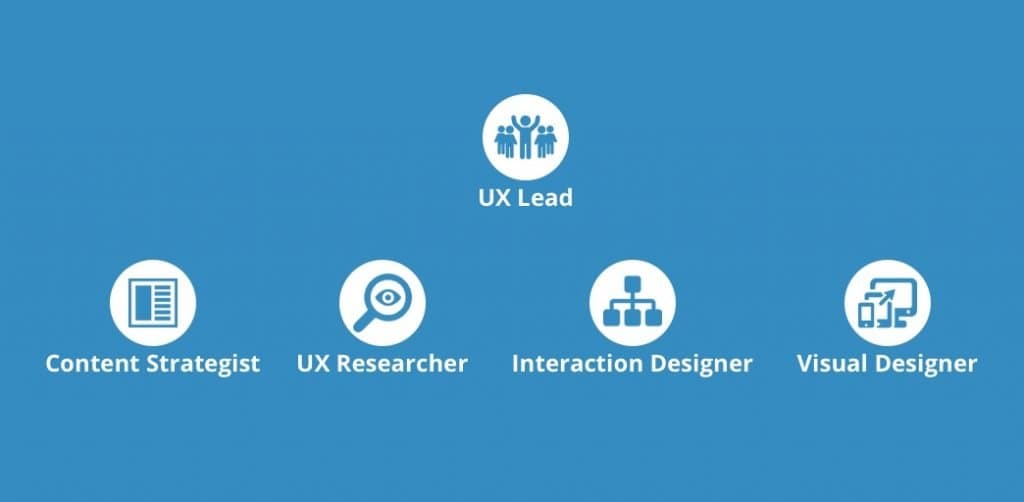
That's when a UX team is born: a group of specialists each covering a different slice of the user experience. The roles aren't rigid — they shift from company to company, overlap, get renamed — but there are five key figures you'll almost always find in mature teams, in the US, UK, and across Europe.
This article describes each one: what they do, what skills are needed, how much they earn in 2026, and how to figure out which role fits you best if you're entering the field.
What you'll learn:
- The 5 canonical roles of a UX team and their responsibilities
- How teams evolve from 1 to 10+ people
- Salary ranges per role in the US and UK for 2026
- Which role to pick based on your background
- How teams differ between startups and enterprises
1. UX Researcher
What they do. The UX Researcher turns curiosity about "who our users are and what they actually want" into actionable answers. They run interviews, manage usability tests, design surveys, analyze qualitative and quantitative data, and deliver insights that drive team decisions.
It's the most methodical role on the team. A good researcher knows how to pick the right technique for the question — often the least visible and most underrated skill, but the one that separates a team that designs "by gut feel" from one that designs with evidence.
Typical responsibilities:
- Defining research objectives for each sprint or project
- Recruiting and interviewing users (5–10 a week in active teams)
- Running moderated and unmoderated usability tests
- Synthesizing findings into insights, opportunities, recommendations
- Maintaining a research repository (personas, journeys, insight DB) accessible to the rest of the company
- Coaching product managers and designers on correct methodology use
Key skills: active listening, writing unbiased questions, critical thinking, workshop facilitation, clear and concise report writing.
Typical tools: Dovetail for synthesis, Lookback or UserTesting for remote studies, Maze for unmoderated testing, Notion or Confluence for the repository, Miro or FigJam for workshops.
Salary 2026 (US · UK): junior $70–90k · £30–40k, mid $95–130k · £42–58k, senior $130–175k · £60–85k, principal $175–240k · £85–120k. Per BLS and Glassdoor data, senior pure-research roles are rare and highly contested in both markets.
Good fit for: people coming from social sciences, psychology, anthropology, investigative journalism, HR, teaching. Those with a natural instinct for "understanding people" who get bored chasing pixel-perfect details.
2. Interaction Designer
What they do. The Interaction Designer (IxD) designs how the user interacts with the system. It's the classic heart of the craft. They translate research insights into flows, wireframes, interactive prototypes, and behavior specs.
If research answers "what should we build", interaction design answers "how should it behave". Every button, every transition, every error state, every edge case is their decision.
Typical responsibilities:
- Translating insights into user flows and information architecture
- Creating wireframes and clickable prototypes
- Specifying behaviors, states (loading, empty, error, success), edge cases
- Facilitating design reviews with product, engineering, stakeholders
- Running usability tests on their own prototypes before handoff
- Contributing reusable interaction patterns to the design system
Key skills: flow-based thinking, systems logic, anticipating edge cases, visual communication of complex intent, advanced Figma mastery.
Typical tools: Figma (core), FigJam for flows, ProtoPie or Origami for motion-heavy prototypes, Maze for prototype testing.
Salary 2026 (US · UK): junior $75–95k · £32–42k, mid $100–135k · £45–62k, senior $135–180k · £62–88k, principal $180–245k · £88–125k. The most widespread role — and therefore the most competitive.
Good fit for: people coming from front-end development, architecture, engineering, product management. Those who think in systems and constraints.
3. Visual / UI Designer
What they do. The Visual Designer — or UI Designer, the two terms overlap in most companies — dresses the interactions defined by the IxD in pixels. Typography, color, grids, components, visual states, motion, icons. Their final output is the interface engineers will build.
In 2026 the role is increasingly tied to the design system: not producing one-off screens but coherent component systems that scale across dozens of screens without losing cohesion.
Typical responsibilities:
- Defining the digital visual identity of the product (typography, palette, grids, spacing, radius)
- Designing design system components with all states and variants
- Creating final screens ready for handoff
- Ensuring visual consistency across all touchpoints
- Working closely with the motion designer (when one exists) and front-end engineers
- Meeting accessibility standards — WCAG 2.2, ADA, and Section 508 — for contrast, sizing, states
Key skills: mastery of typography and color systems, eye for detail, deep Figma knowledge (components, variants, auto-layout, libraries), sensitivity to animation and microinteractions, accessibility awareness.
Typical tools: Figma as the center of gravity, motion tools like Rive or Lottie, Zeplin or Figma directly for handoff, plugins like Stark for accessibility.
Salary 2026 (US · UK): junior $70–90k · £30–40k, mid $95–130k · £42–58k, senior $130–170k · £58–82k, principal $170–230k · £82–115k. A widespread role; principals running mature design systems, on the other hand, are rare.
Good fit for: people coming from graphic design, illustration, art direction, web design. Those who already have an eye for composition and typography.
4. Content Strategist / UX Writer
What they do. The youngest role on the team but also the fastest growing. The Content Strategist handles everything textual in the interface: microcopy (labels, buttons, errors), voice & tone, feature naming, guided content.
At a more strategic level, they manage how the product "speaks" overall: tone of voice, cross-product terminology consistency, onboarding content, transactional email, notifications.
Typical responsibilities:
- Writing and reviewing microcopy across all screens
- Defining and maintaining voice & tone guidelines
- Collaborating with IxD and UI Designers from the earliest phases (not "arriving at the end to patch holes")
- A/B testing different wording on critical messages (CTAs, errors, onboarding)
- Managing design system terminology (glossary)
- Coordinating with marketing to ensure consistency between external comms and in-product copy
Key skills: concise, functional writing, ear for brand voice, knowledge of UX writing principles, cultural sensitivity (localization), ability to collaborate with designers and engineers.
Typical tools: Figma (working in place on mockups), Notion for guidelines, Google Docs for reviews, Ditto or Frontitude for centralized copy management.
Salary 2026 (US · UK): junior $65–85k · £28–38k, mid $90–125k · £40–55k, senior $125–165k · £55–78k, principal $165–220k · £78–110k. Still an emerging specialty — many companies cover it with generalist UX designers. Those who specialize early face less competition.
Good fit for: people coming from journalism, copywriting, translation, publishing, content marketing. Those already fluent in words who want to bring that craft to digital.
Read more: what UX writing is and what a UX writer does.
5. UX Lead / Design Director
What they do. The management and representation role for design within the company. They no longer design (or do so rarely): they manage designers, defend the value of design to the business, coordinate the product vision from an experience standpoint.
A UX Lead typically guides 4–10 designers. A Design Director manages multiple leads and sits at the C-suite table with CTO, CPO, CEO.
Typical responsibilities:
- Defining design strategy aligned with product and business goals
- Hiring, evaluating, and growing designers on the team
- Ensuring the quality of design decisions (critique, review, mentorship)
- Defending design in front of non-technical stakeholders (budget, priorities, scope)
- Defining process: how research is done here, how critique works, how handoff happens
- Representing the team at keynotes, conferences, external communications
Key skills: leadership, people management, public speaking, translating design into business value, organizational political awareness, strategic vision.
Typical tools: Notion/Confluence (documentation), Slack (a lot), Figma (a little), presentation slides (a lot).
Salary 2026 (US · UK): lead $170–230k · £85–120k, director $220–320k · £120–170k, VP Design $300–480k+ · £170–260k+. Principal individual contributors (with no people-management responsibility) can earn comparable compensation at the most mature companies.
Good fit for: senior designers with 7–10+ years of experience who discover they love people management more than pixels. It's not a mandatory path: many excellent seniors prefer to stay "individual contributors" as principal designers — and they're right to.
How teams evolve: from startup to enterprise
The composition of a UX team changes radically with company maturity.
1-person team. Early-stage startup, traditional small business. One person covers research, IxD, UI, UX writing. It's a survival phase: you cut corners, work by instinct. Viable for 6–18 months, then design debt becomes unmanageable.
2–3 person team. Scale-up, product with traction. Typically: 1 generalist product designer (IxD+UI) + 1 UI more focused on visual + possibly 1 part-time or on-demand freelance researcher.
4–8 person team. Mature company, established product. Specialization appears: 1 lead + 2–3 product designers + 1 dedicated researcher + 1 content strategist. The design system is formally maintained.
10+ person team. Enterprise, multinationals, unicorns. Design is a structured function with sub-teams per product area. Niche roles appear: design system lead, accessibility specialist, dedicated motion designer, design ops (process, tools, budget).
Most UX jobs in the US and UK sit in teams of 2 to 8 people. Below that threshold the designer is often too isolated to grow; above it, the companies are few and highly selective.
Which role to pick if you're starting now
If you're getting started and want to build your path, two practical pieces of advice:
- Start as a generalist for the first 2 years. Nobody hires a "junior specialist". The best juniors cover a reasonable breadth of tasks and then, at the mid transition (year 2–3), choose where to specialize.
- Specialization follows real interest, not trends. If interviews drain you, don't become a researcher. If you can't tell one font from another, don't aim for visual. Try each area for 3–6 months and pick the one where you enter flow.
Frequently asked questions
Is a Product Designer one of the 5 roles listed?
Product Designer is an umbrella label typically used for someone who covers IxD + UI maturely. It's the most common role at mid-sized tech companies in the US, UK, and Europe. A senior product designer is often the practical equivalent of "interaction designer + visual designer in one person".
Do UX designers earn more than UI designers?
No — ranges are comparable for the same seniority level. Salary differences depend more on company, city, and tenure than on the specific title. A senior UI designer at a company that values the design system can earn more than a junior "generalist" UX designer.
Do you need a UX writer in a team of 3 designers?
Rarely full-time. In small teams, writing is distributed across designers or handed to a marketing content writer with UX sensibility. The dedicated role appears from 5–6 designers onward, or at companies where copy is business-critical (fintech, edtech, healthcare).
Can I build a career as a designer without ever becoming a lead?
Yes — and it's an increasingly common choice. The path is called Individual Contributor (IC) and leads to roles like Senior → Staff → Principal → Distinguished. At mature companies, a principal designer has compensation and influence comparable to a Design Director, without the people management.
What's the hardest role to hire for in the US and UK?
Senior UX Researcher and Content Strategist. Two roles where demand grows faster than supply, and where candidates with 3–5 years of solid experience receive offers regularly.
Next steps
If you want to figure out which of these roles is right for you, the next steps are:
- Read what a UX designer does to get the generalist picture
- Go deeper on career-change paths by background
- Check salaries for each role in detail
In the complete CorsoUX path you study all 5 areas described here, so by the time you're ready to specialize, you'll have hands-on experience with each before choosing.