
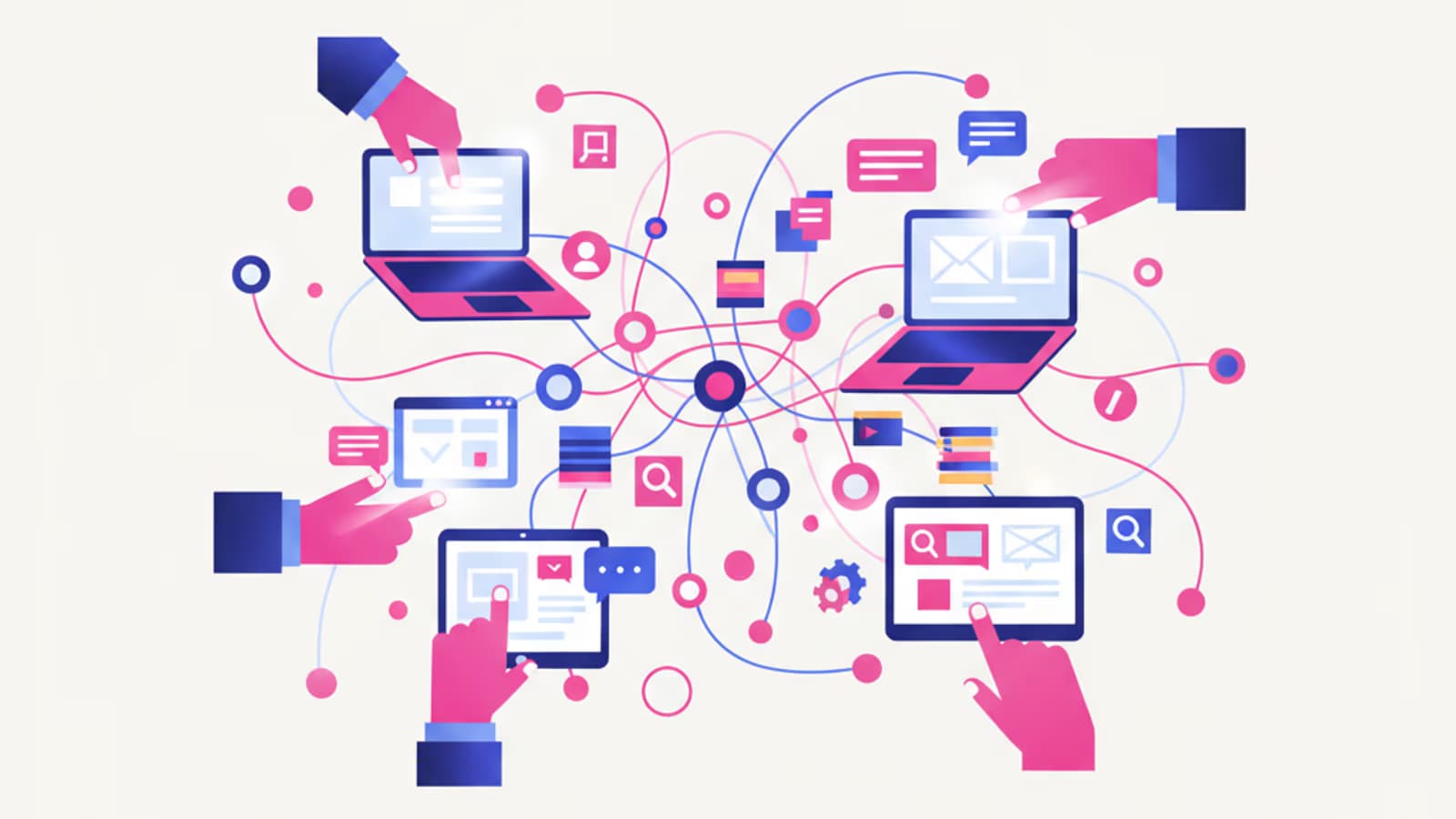
In 1995, cognitive anthropologist Edwin Hutchins published Cognition in the Wild, a book based on years of observation aboard a large US Navy ship. Hutchins studied how the crew navigated — not individual sailors "thinking" about the route in their heads, but a distributed system of people, instruments (charts, sextants, onboard computers), procedures, and communication that together produced the act of navigation. No single individual held all the information and all the calculations in their head. Navigation was a distributed cognitive phenomenon: thinking lived in the system, not just in minds.
Thirty years later, that concept has found new relevance in UX Design. When we design digital interfaces in 2026 — in a world where users simultaneously use multiple devices, AI tools, support communities, documentation, and coworkers — we are not designing for an isolated mind. We are designing for a cognitive ecosystem in which the user is only one of the nodes.
This article explores what distributed cognition means for contemporary UX Design, what practical implications it has on design decisions, and why it's a particularly valuable lens in the era of integrated AI tools.
What you'll learn:
- What distributed cognition means according to Hutchins
- The 4 dimensions of "extended thinking" relevant to design
- How the designer's role changes once you accept this perspective
- Practical implications for products that integrate AI
- The ethical risks of designing for an extended cognitive system
What distributed cognition is
Distributed cognition theory argues that cognitive processes are not confined to an individual's brain. They extend to the body (we use gestures to remember), to tools (taking notes amplifies memory), to the environment (the arrangement of objects on a desk organizes thinking), and to other people (talking through a problem produces insights we wouldn't reach alone).
Hutchins identifies three types of distribution:
- Socially distributed: cognition lives across different people collaborating
- Embodied: thinking uses the physical body for cognitive tasks
- Extended: tools and environments become part of the cognitive system
This view contrasts with the traditional perspective that thinking is a purely internal activity of the brain. And it has huge practical consequences for anyone designing interfaces: if the user doesn't "think alone", your design shouldn't only optimize for individual cognitive load — it should optimize for the entire system the user operates in.
The 4 dimensions of extended thinking in UX
1. Tools as cognitive extensions
A user using your app doesn't think in isolation. They're also checking their phone, taking notes, maybe chatting with a coworker. If your design assumes the user has all their attention on the product, it's ignoring operational reality.
Practical implication: design for multi-tasking attentional contexts. Critical information must be easy to recover after an interruption. State must be saved. Paths must survive distractions.
2. Documentation as external memory
A designer building enterprise software knows that users don't "memorize" the 200 features of a product. They search for them when needed — in documentation, in internal search, on Google, by asking coworkers. The user's memory is not in their head, it's distributed across the informational system around the product.
Practical implication: internal search is a first-class interface, not an accessory. Help content must be updated as often as the product. Contextual tooltips reduce the need for memory by assuming the user has forgotten.
3. Community as distributed cognition
In products with active communities (Notion, Obsidian, Figma), an enormous part of learning happens outside the product: forums, YouTube, Reddit, Slack communities. The user who "knows how to use Figma" learned 20% from the tool itself and 80% from external tutorials.
Practical implication: the product is part of a larger ecosystem. Supporting the community (open APIs, public templates, open documentation) is strategic design, not secondary marketing.
4. AI as a new cognitive partner
Since 2023 users have had a new cognitive partner always available: generative AI. ChatGPT, Claude, and Gemini get queried dozens of times a day to explain, rephrase, and search. The thinking of the user using your product now includes AI as an external node.
Practical implication: your product no longer competes with the user's memory, it competes with how quickly they can ask AI. If your documentation is worse than the answers ChatGPT gives on similar topics, your documentation won't get used.
How the designer's role changes
The distributed cognition perspective changes the craft in three ways:
1. From "user design" to "system design"
A good designer doesn't just optimize the interface: they optimize the entire cognitive system the user operates in. That includes APIs, documentation, community, and integration with other tools. The product's boundary extends beyond the screen.
2. From "reducing cognitive load" to "distributing it well"
Classic usability principles (Nielsen) talk about reducing the load on user memory. Distributed cognition adds a nuance: the load doesn't just need to be reduced, it needs to be distributed across reliable external resources (documentation, autocomplete, history, suggestions).
3. From individual user to collaborative system
Many modern products don't have a user, they have a team. Figma, Notion, Google Docs — the "thinking" that happens during use is intrinsically collaborative. Designing for a solo user in these contexts means ignoring half the value.
Ethical implications and risks
A distributed-cognition view brings ethical risks that need to be confronted explicitly.
1. Dependency vs autonomy
If a user keeps externalizing more of their thinking to the product, they become progressively dependent on it. This can be beneficial (outsourcing boring tasks) or damaging (loss of independent skills). Where do we draw the line?
2. Distributed responsibility, diluted responsibility
If a decision is made by the extended cognitive system (user + tool + AI + community), who is responsible when something goes wrong? Diluted responsibility is a live philosophical issue in the design of AI tools — and the UX Designer is an active part of it. In the US, the FTC has already started asking where the line of accountability falls.
3. Privacy in the extended cognitive system
When the user's thinking "lives" also outside their head (on product servers, in AI chats, in shared notes), where are the boundaries of privacy? What belongs to the user and what belongs to the system? Under CCPA and evolving US privacy frameworks, these questions increasingly have legal weight on top of their ethical one.
These are not abstract questions: every design decision addresses them implicitly. A designer aware of distributed cognition addresses them explicitly, with intention.
A practical example: Notion as an extended cognitive system
Notion is an interesting case study of a product designed (consciously or not) along distributed cognition principles.
- Databases as external memory: information doesn't have to be memorized by the user, it lives in linked databases
- Powerful search: retrieval matters more than remembering
- Integrated AI: natural language questions over your own data
- Community and templates: users don't invent structures from scratch, they copy them
- Live collaboration: thinking is distributed across team members
The result: Notion users don't use their memory for information, they use it to decide what to look up. Cognitive load is distributed, not eliminated.
This is design aware of distributed cognition, even if no one at Notion ever cites Hutchins explicitly.
Toward a sustainable future for design
The final question distributed cognition poses to designers is a deep one: are we building cognitive systems that amplify human intelligence, or that replace it? These two possibilities are not equivalent, and they are not ethically neutral.
A cognitive amplifier makes the user more capable — it lets them do things they couldn't do alone, but with their own skills growing through use. A cognitive substitute does the work for the user — quickly, efficiently, but leaving them less capable over time.
The 2026 designer, facing products integrated with AI, has to consciously choose between these two directions. There is no absolute "right" answer — it depends on the domain, the audience, the intent. But choosing without being conscious of the choice is the real mistake.
Next steps
Distributed cognition is a powerful theoretical lens that enriches the designer's thinking. To go deeper:
- Read what User Experience Design really is for the broader context
- Study the classic usability principles that integrate with this perspective
- Explore user research methods to observe how users actually use tools in their ecosystem
In the free UX Design course from CorsoUX we tackle these theoretical themes alongside daily craft, showing how philosophical ideas translate into concrete design decisions.