In 2010, a "Web Designer" was a much more well-defined role than it is today. You designed websites, knew some Photoshop, some HTML and CSS, built layouts to show the client, and then implemented them. It was the only creative digital role alongside the traditional graphic designer.
In 2026 that role still exists, but it's only one slice of the landscape. Next to the classic Web Designer, the world of UX Design has taken shape — a practice that doesn't design "websites" but experiences. The difference isn't cosmetic, it's fundamental. Two related but distinct crafts, with different study paths, different career outcomes, and different salaries.
If you're choosing a course and you're torn between a "Web Design course" and a "UX Design course", this article will help you understand the real differences and make an informed choice.
What you'll learn:
- The real difference between Web Design and UX Design in 2026
- What you study in a Web Design course vs a UX Design course
- Career outcomes for each and their salaries in the US and UK
- Which path you need based on your goals
- Why for many people the answer is "both, in this order"
Web Design and UX Design: two different disciplines
The classic Web Designer designs websites: corporate homepages, marketing sites, blogs, landing pages. The output is visual and technical at once: an aesthetically coherent layout, typographically tight, responsive, buildable with HTML/CSS (often on a CMS like WordPress or Webflow). Success is measured in: aesthetics, loading speed, brand consistency, and client satisfaction.
The UX Designer designs interactive experiences across any digital platform: websites, mobile apps, dashboards, SaaS products, embedded software. The output is conceptual more than visual: flows, wireframes, prototypes, interaction specs, architecture decisions. Success is measured in user-behavior metrics: task completion rates, decision times, conversion, retention.
Where they overlap
The two crafts meet in a specific place: both use Figma (or similar tools), both need to understand grids, typography, color, accessibility, and responsive design. A modern Web Designer who wants to stay relevant has to learn UX methods; a UX Designer working at a small scale-up or an agency often has to ship finished layouts like a Web Designer would.
Where they diverge
The real divergences are three:
- Method. A Web Designer starts from a client brief and designs. A UX Designer starts from the user, does research, tests, and only then decides what to build. The UX method is slower but produces decisions you can defend with data.
- Scale of impact. A Web Designer typically works on sites a person visits 1–3 times. A UX Designer works on products used every day by tens of thousands — sometimes millions — of people. The weight of each decision is different.
- Type of client. Web Design: small and medium businesses, professionals, local brands. UX Design: product companies (startups, scale-ups, Fortune 500 tech, SaaS leaders with internal product teams).
What you study in a Web Design course
A classic Web Design course in 2026 covers these areas:
- Visual design principles: typography, color, grids, composition, visual hierarchy
- Design tools: Figma, occasionally Sketch for legacy workflows
- Modern HTML and CSS: flexbox, grid, responsive, basic animations, CSS variables
- CMS or builders: WordPress + Elementor/Bricks, Webflow, Framer, or static builds
- Hosting and domains: the technical basics to get a site live
- Technical SEO basics: meta tags, performance, semantic accessibility
- Image handling and photography: optimization, modern formats (webp, avif)
- Client work + real project: how to handle a brief, present, and iterate
The deliverable of a Web Design course is typically a complete, published website. Someone leaving a serious program can realistically land their first freelance clients within 3–6 months.
What you study in a UX Design course
A UX Design course covers a completely different perimeter:
- User research: interviews, usability tests, surveys, data analysis, personas, journey maps
- Information architecture: sitemaps, user flows, card sorting, tree testing
- Interaction design: wireframes, prototypes, interaction patterns, microinteractions
- Product visual design: focused on design systems and components more than "pretty sites"
- UX writing: microcopy, empty states, error messages, voice and tone
- Accessibility: WCAG 2.2, ADA and Section 508 compliance, screen readers, inclusive design
- Product metrics: how to measure whether a design works (conversion, retention, task success)
- Collaboration with engineers and PMs: how to operate inside a product team
The deliverable of a UX course is typically 2–3 documented case studies: problem, research, decisions, prototype, test, outcome. Someone leaving a serious program can apply for junior UX Designer roles in product teams at US and UK companies.
Career outcomes and salaries
Web Designer (classic)
Where you work: digital agencies, graphic/web design studios, freelance with SMB clients, one-person shops handling the whole "site + email + social" stack.
Salary ranges — United States 2026 (sources: US Bureau of Labor Statistics, Glassdoor US, Built In):
- Junior: $52k–$68k
- Mid: $68k–$92k
- Senior: $92k–$125k
Salary ranges — United Kingdom 2026 (sources: Glassdoor UK, LinkedIn Workforce Report):
- Junior: £28k–£38k
- Mid: £38k–£55k
- Senior: £55k–£75k
Freelance ranges are far more variable: from $500–$2,000 for a small brochure site to $15,000–$50,000 for a structured corporate site. A mature freelance Web Designer in a major US city can bill $90k–$160k/year, with peaks above $200k for specialists in Webflow or Framer working with venture-backed startups.
UX Designer
Where you work: scale-ups, US and UK tech companies, internal product teams at Fortune 500s, product consultancies, and freelance on structured engagements.
Salary ranges — United States 2026 (sources: Levels.fyi, Glassdoor US, Built In):
- Junior: $80k–$110k
- Mid: $110k–$150k
- Senior: $150k–$200k
- Lead/Principal: $200k–$290k+ (top of market at Google, Meta, Apple, Airbnb can exceed $350k total comp including stock)
Salary ranges — United Kingdom 2026 (sources: Glassdoor UK, Hired UK Report):
- Junior: £40k–£55k
- Mid: £55k–£80k
- Senior: £80k–£115k
- Lead/Principal: £115k–£155k
For the complete breakdown read the UX Designer salary guide.
Which market is bigger?
The classic Web Design market is bigger in volume of jobs but smaller in spend per project. Thousands of small clients who want a $2,000 site. The UX Design market is smaller in volume but far larger in spend per hire: tens of thousands of product-led companies that hire designers full-time at $110k–$150k a year for 3–5 years.
Growth over the last five years has been almost entirely on the UX side, according to the US Bureau of Labor Statistics occupational outlook. Classic Web Design is growing slowly and is often eroded by drag-and-drop builders that let non-designers ship decent sites on their own.
Which course to pick: 4 profiles
Profile 1: "I want to build sites for clients and go freelance"
Pick Web Design. Web Design courses with a practical focus on Webflow, Framer, or WordPress let you land clients quickly. Add technical SEO and client-management skills and you have a self-sufficient profession.
Sustainable earnings target: $80k–$150k/year as a freelancer after 2–3 years.
Profile 2: "I want to work at a tech company or scale-up"
Pick UX Design. Product companies don't hire "web designers" — they hire UX/UI or product designers. A UX course is your entry point into this world.
Sustainable earnings target: $110k–$180k at mid-market companies in the US, £55k–£95k in the UK, significantly higher at FAANG and top SaaS.
Profile 3: "I don't know yet, I want to keep my options open"
Pick UX Design and add Web Design modules later. UX is harder to learn but opens more doors. A UX Designer can easily slide into doing Web Design work; the reverse is much harder.
Our complete program covers UX + UI + a practical Web Design block.
Profile 4: "I'm already a classic Web Designer, I want to evolve"
Add a UX Design course to your path. You don't need to start over — your visual and technical foundations are an accelerator. What you're missing is the method (research, flows, metrics). Read the reconversion profiles for the specific journey of web designers in transition.
How a complete UX Design course is structured
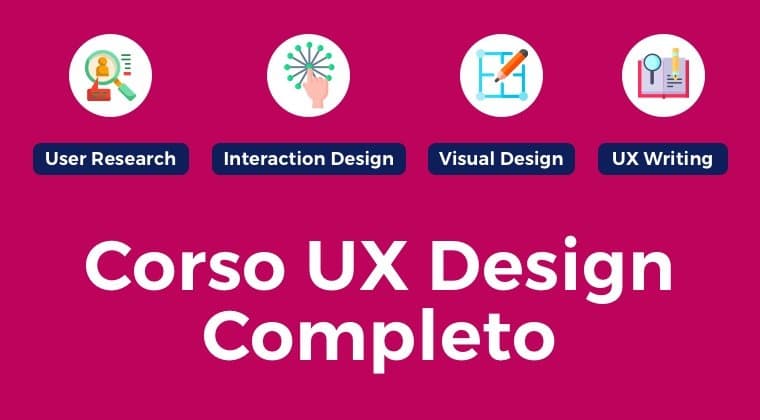
To give a concrete sense of what "complete UX Design course" means, here's the typical structure (and the one we follow):
Module 1 — User Research
How to run interviews, usability tests, competitor analysis, persona building, and insight synthesis. It's the foundation of the UX method — the most important module and the one most often underestimated.
Module 2 — Interaction Design
Information architecture, flows, wireframes, prototypes in Figma. Where the "how it works" of the product is built.
Module 3 — Visual Design
Typography, color, grids, components, design systems, accessibility. The layer that makes your design look polished and coherent.
Module 4 — UX Writing
Microcopy, error messages, voice and tone, onboarding. The piece often ignored by mediocre courses — and a massive differentiator in interviews.
Module 5 — Final project and portfolio
A complete end-to-end case study that becomes the centerpiece of your portfolio. Without this, the rest of the program is worth less than half of what it should be.
A serious complete course has to cover all 5 modules. Courses that only cover 1–2 are useful for going deeper but aren't enough to break into the market.
Frequently asked questions
Can a Web Designer become a UX Designer?
Yes, and it's a natural transition. Web Designers already have the visual foundations, Figma fluency, and digital-world awareness. What they need to add is the UX method: research, flows, metrics. In 6–9 months of focused study, the transition is complete.
Which course costs more?
UX Design courses generally cost more than classic Web Design courses because they cover more ground and often include mentorship. Focused Web Design courses (e.g. Webflow-only) are shorter and cheaper. US bootcamps for UX Design range from $7,000 to $16,000; Web Design bootcamps range from $3,000 to $10,000.
Do I need to code to be a Web Designer in 2026?
Reading HTML and CSS at a basic level has become a minimum requirement for any web professional. Advanced coding (JavaScript, frameworks) isn't mandatory but is a strong differentiator in the US and UK job market.
Do Web Design courses also teach UX?
Serious ones do, at an introductory level — but only superficially. You'll never see a Web Design course dedicate 50 hours to user research alone, the way a vertical UX course does. If UX matters to you, study a vertical course.
Can I learn both at the same time?
Yes, but sequentially, not in parallel. Learning Figma at a serious level requires focus and 30–50 hours of deliberate practice — splitting that across two concurrent courses slows you down. Better to finish one and then tackle the other.
Next steps
Choosing between Web Design and UX Design isn't permanent: it's an entry point. Plenty of designers switch paths over the course of their career.
The practical steps:
- Decide your primary goal: freelance with clients or employed at a product company?
- Assess your current situation: starting from zero, or already in digital?
- Read our guide on how to become a UX Designer in 12 months if you pick the UX path
- Compare US, UK and international course options if you're looking for specific programs
The CorsoUX complete program covers all 5 areas of UX Design with personal mentorship. It's designed for people who want to enter product teams at US, UK and international companies — starting from zero or transitioning from another digital role.