
"Do I need a UX certification to get hired?" It's one of the most common questions from people breaking into the field. The honest answer: a certification alone won't land you a job, but the right one at the right moment can accelerate your path, give structure to your studies and fill a credibility gap when you don't yet have demonstrable experience.
The problem is that the UX certification market is crowded and opaque. Some credentials are recognized everywhere; others are marketing dressed up as education; others are great for specific profiles and useless for others. This guide compares the main certifications available in 2026, what they really signal on a US or UK CV, and how to choose.
What you'll learn:
- When a certification actually helps — and when it doesn't
- The 7 best-known UX certifications compared honestly
- How much they cost, how long they take, and what you actually get
- Which credential carries more weight in US vs. UK hiring
- What counts more than the certificate (spoiler: the portfolio)
When a certification actually matters
Certifications don't get you hired. That's what every senior UX recruiter we've spoken to repeats, and it's confirmed by former students of ours who now sit on the other side of the interview table. What gets you hired is the portfolio. Full stop.
That said, a certification can genuinely help in four specific situations:
- You're starting from zero and need structure. Without a path, most self-learners drift through random articles for months. A structured course forces a logical sequence.
- You need an initial credibility signal. On a career-switcher's CV, "Certified by X" outperforms "I've read a lot of UX blogs." It's a weak signal, but better than nothing.
- You're targeting employers that require formal credentials. Some Fortune 500 companies, federal contractors subject to Section 508, and large UK public-sector employers have HR policies that expect a recognized certification.
- You want access to a community and structured feedback. The real value isn't the certificate — it's the mentor, the graded exercises, and the peer network.
A certification is not needed if you already have 2+ years as a designer, a portfolio with real projects and metrics, and you aren't chasing roles behind strict HR gates. In that case the portfolio speaks for itself.
The 7 best-known UX certifications in 2026
1. Google UX Design Certificate (Coursera)
What it is. A seven-course online path on Coursera, built by Google. It covers UX fundamentals from research to portfolio. The most popular in the world by enrolment (1M+ students).
Duration: 6 months part-time advertised; realistically 4–8 months.
Cost: ~$49/month on Coursera — roughly $200–$400 total.
Language: English.
Pros:
- The Google brand lands well with non-technical recruiters on both sides of the Atlantic.
- Well structured for absolute beginners.
- Huge community and plenty of supporting resources.
Cons:
- Generic content, tuned to a US-centric market but shallow on nuance.
- No real mentor: assignment reviews are peer-to-peer and quality depends on your cohort.
- Final portfolio projects are recognizable ("another Google Certificate case study") to experienced hiring managers in Silicon Valley and London.
- Little depth on advanced topics (design systems, accessibility audits, enterprise research).
Best for: complete beginners who want an affordable, structured first step.
2. Nielsen Norman Group UX Certification
What it is. The most authoritative credential in the industry, issued by the research group founded by Jakob Nielsen and Don Norman. You earn it by accumulating credits through individual workshops (4–8 hours each) online or in person in New York, London and San Francisco.
Duration: flexible — 3 months to several years (5 core courses + 1 elective).
Cost: around $1,100–$1,500 per course. Total: $6,000–$10,000.
Language: English.
Pros:
- Maximum authority. "UX Certified by Nielsen Norman Group" is a strong signal, particularly for senior research roles.
- Up-to-date content, noticeably above average quality.
- Great for deepening specific areas (advanced research, enterprise UX, design management).
Cons:
- Cost is prohibitive unless your employer funds it.
- Courses are aimed at practitioners, not career switchers.
- It produces no portfolio — it's theory and methods, not practice.
Best for: practitioners already in the field (3+ years) who want to go deeper or position themselves for senior roles. Not for beginners.
3. Interaction Design Foundation (IDF)
What it is. A Danish online UX school with dozens of subscription-based courses. It issues a certificate of completion for each course.
Duration: 4–12 weeks per course.
Cost: ~$16/month subscription, lower for students. Around $150–$300 per year.
Language: English.
Pros:
- Best value-for-money on the market.
- Wide catalog: you can focus on specific domains (Design Thinking, HCI, research, accessibility).
- Content written by serious academics and practitioners.
Cons:
- IDF certificates carry moderate weight in US/UK hiring — less recognizable than Google or NN/g.
- Very text-heavy format, light on video and interaction.
- No real mentorship.
Best for: self-learners who want structured study on a tight budget, or practitioners broadening their range in specific areas.
4. CorsoUX — UX Design Certification
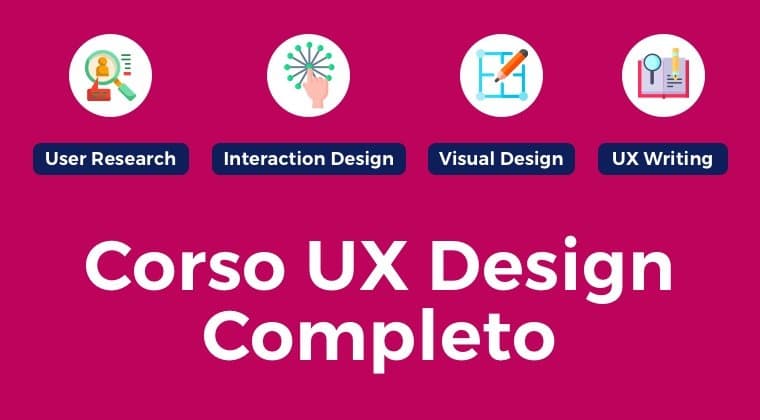
What it is. Our own program, listed here for transparency. An online course with four modules (User Research, Interaction Design, Visual Design, UX Writing) and a bundle option with a final certification. Italian-language, originally built for the Italian market.
Duration: 6–10 weeks per module, 3–4 months for the full bundle.
Cost: significantly cheaper than NN/g, comparable to mid-tier English-language bootcamps.
Language: Italian.
Pros:
- The only complete UX certification designed specifically for the Italian market.
- A personal mentor reviews every exercise (unlimited 1:1 feedback — unique in this list).
- You build a real portfolio during the course, not at the end.
Cons:
- Less recognizable brand in the US and UK hiring markets.
- Italian language only — not the right pick if you want to work in an English-speaking market from day one.
Best for: Italian speakers targeting the Italian market. Not the right choice if you're going straight into US or UK senior roles.
5. Figma Academy / Figma Certification
What it is. In 2024 Figma started issuing official certifications for tool proficiency. It's not a UX design certification — it validates mastery of the tool.
Duration: short, typically a few weeks of prep.
Cost: modest exam fee ($70–$100). Prep material is free.
Language: English.
Pros:
- Directly validates a skill that every US and UK job posting lists.
- Low cost, quick to earn.
- Kept up-to-date by Figma themselves.
Cons:
- It doesn't make you a UX Designer. It only validates tool fluency.
- Only makes sense as a complement to broader UX training, not a substitute.
Best for: people who already have UX fundamentals and want to certify Figma mastery — or designers migrating from Sketch or Adobe XD.
6. US/UK Bootcamps (CareerFoundry, Designlab, General Assembly, Memorisely)
What they are. Intensive 3–9 month programs, full- or part-time, online with mentors and career support. The most mature bootcamp market is in the US and UK.
Duration: 3–9 months.
Cost: $6,000–$15,000 typically.
Language: English.
Pros:
- Very intensive, with career coaching aimed at landing your first job.
- Strong alumni networks in Silicon Valley, New York and London tech.
- Several appear consistently on the LinkedIn Jobs on the Rise lists of credentials employers recognize.
Cons:
- Expensive.
- Quality varies: some are excellent, others are slick marketing. Read independent reviews before signing up.
- Career support is usually US/UK-focused — less relevant if you want to stay in continental Europe.
Best for: people with budget, full-time availability, and explicit goals in US or UK tech hiring.
7. HFI CUA / CXA Certification (Human Factors International)
What it is. The "Certified Usability Analyst" and "Certified User Experience Analyst" credentials from a long-standing usability consultancy. Very formal, aimed at large enterprises and consultancies.
Duration: an intensive 5-day course plus exam.
Cost: $3,000–$4,500 in total.
Language: English.
Pros:
- Recognized inside large enterprises and traditional IT consultancies (including federal contractors where WCAG 2.2 / Section 508 compliance is mandatory).
- Short, intensive format.
Cons:
- More traditional than modern product design practice.
- High cost for the content delivered.
- Limited added value for anyone working in modern digital products.
Best for: people targeting IT consultancies, federal agencies, insurance groups and banks that value formal credentials.
How to choose: a quick matrix
Five profiles and the certification we'd recommend for each:
- "I'm starting from zero and want to work in US tech" → Google Certificate + a mid-tier bootcamp (Designlab or CareerFoundry) if you have budget.
- "I want a UK tech job as a career switcher" → Google Certificate + General Assembly or Memorisely, plus a real portfolio side project.
- "I already work in digital and want to formalize UX skills" → IDF or NN/g (especially if your employer pays).
- "I'm senior and want to specialize in research or enterprise UX" → NN/g, targeted individual courses.
- "I just want to certify Figma mastery" → Official Figma certification.
What matters more than the certificate
To be blunt: none of the above certificates, on its own, will land you a job. Three things matter more, according to every US and UK recruiter we've talked to:
- A portfolio with real case studies and metrics. It's about 70% of the interview.
- The ability to narrate design decisions behind each project articulately and self-critically.
- Cultural fit with the team (curiosity, humility, willingness to learn).
The certificate is at most 10% of the interview. Its only job is to "prove" you're not bluffing when you say you know the material. It's a weak signal. The portfolio is a strong signal.
If you have to choose where to invest time and energy, invest in the portfolio.
Frequently asked questions
Is a UX certification globally valid?
No UX certification is formally "valid" in a legal sense, the way certain licensed professions are. All UX certifications are private, issued by companies or schools. Their value is reputational and varies by market.
Is a design degree worth more than a certification?
For a junior role, a design degree (or HCI or cognitive psychology) is worth slightly more than a certification — but the portfolio weighs a lot more than both. At mid+ levels the difference disappears.
Is it worth taking more than one certification?
Usually no. Two certifications aren't worth twice one. Better a solid certification plus time invested in the portfolio. Exception: a broad certification (e.g. CareerFoundry full track) plus a specific one (e.g. official Figma cert or NN/g in a specialty area) can complement each other.
How important is certification for the first UX job?
For the first job it matters mostly as a "credibility signal" when your portfolio is still weak. It's 15–20% of the hiring decision. For the second job it drops below 5%. At mid+ it almost disappears.
Can I become a UX Designer without any certification?
Yes. A serious self-taught path with a solid portfolio is legitimate and common — plenty of successful designers followed it. It demands a lot of discipline and a feedback community — two things a structured certification delivers out of the box. The money you save becomes a cost in time and effort.
Next steps
If you've decided to pursue a certification, the next steps are:
- Define where you want to work (US, UK, EU) — it radically changes the choice.
- Set an honest budget for training (time plus money).
- Read our guide to becoming a UX Designer in 12 months to place the certification inside your overall path.
- Check the UX designer salary guide to sanity-check the investment against the expected return.
Whatever you pick, don't treat the certificate as the finish line — treat it as a scaffold for the real work: designing real products, documenting your decisions, and building a portfolio that a hiring manager at a Silicon Valley scaleup or a London fintech can skim in 90 seconds and say "let's talk."